How to Choose a Data Center in Israel: A Practical Guide for Business Leaders
The MedOne Handbook. Everything CIOs, IT Directors, and business decision-makers need to evaluate data center and cloud infrastructure in Israel. Straight talk. Real experience. 25+ years building and operating data centers in Israel.
25+Years Operating
72-HrAutonomy Guarantee
99.999%Uptime SLA
ISO 27001Certified
Navigation
Table of Contents
Jump to the chapter that matches your most pressing challenge. If you are in a hurry, Chapter 6 gives you the executive summary.
Not long ago, a company in Israel could manage its data center needs with a server room in the basement, a reliable ISP contract, and a capable in-house IT team. Those days are gone. The convergence of artificial intelligence, hybrid cloud architecture, and increasingly strict data regulations has fundamentally changed what "good" infrastructure looks like.
72 Hours
Contractual Autonomous Operation Guarantee
99.999%
Uptime SLA: Less Than 5 Minutes Downtime per Year
25+ Years
Serving Israel's Defense, Banking and Healthcare Sectors
Why This Matters to Your Business
Every hour of unplanned downtime costs an enterprise an average of USD 300,000 in lost productivity, emergency response, and reputational damage. For financial services and healthcare, that figure is higher. The question is not whether you can afford professional data center infrastructure. It is whether you can afford to go without it.
Your Four Infrastructure Pain Points
Before diving into solutions, here are the problems most Israeli enterprises running on-premises infrastructure are dealing with:
01
Capacity You Cannot Grow Fast Enough
AI workloads require GPU-dense racks drawing 30 to 200 kW each. Your legacy server room was not designed for that. And even if you could upgrade the floor space, getting enough grid power on your timeline is a real and growing constraint in Israel.
02
Resilience That Does Not Match Your Risk Environment
Israel's geopolitical and physical environment is unique. Businesses here cannot afford to treat disaster recovery as a theoretical checkbox. You need contractually guaranteed uptime, not just best-effort SLAs.
03
Compliance Pressure Getting Heavier
PPL Amendment 13 in 2024 mandates Data Protection Officers, requires breach notification within 72 hours, and grants the Privacy Protection Authority significant new enforcement powers. EU GDPR, Bank of Israel, and ISA requirements add further layers.
04
Costs That Do Not Stop Growing
Power bills, maintenance contracts, hardware refresh cycles, cooling upgrades, and the ongoing challenge of hiring qualified data center engineers all add up fast. Every shekel spent keeping aging infrastructure alive is a shekel not invested in your actual business.
Key Insight
On-premises infrastructure made sense when computing needs were predictable and static. In the AI era, your infrastructure needs to scale with your ambitions, not limit them.
Chapter 02
Solving Business Challenges the MedOne Way
Overcoming Performance Limitations
When your leadership team asks why you are recommending a move to a professional data center facility, they will want clear answers on scalability, resilience, cost, and compliance.
Scalability for AI
High-density rack support up to 200 kW per rack, with liquid and air cooling options and 250 MW expansion underway. Reserve capacity today and grow into it as AI and cloud demands increase.
Business Continuity
Contractual 72-hour autonomous operation, even during war, cyberattack, or national grid failure. Backed by Island Mode engineering and on-site fuel reserves.
Cost Control
Shift from unpredictable CAPEX to predictable OPEX. Carrier-neutral competition keeps connectivity costs down. No forced bundling, no hidden incentives.
Compliance
Data sovereignty on Israeli soil. Aligned with PPL Amendment 13, Bank of Israel requirements, ISO 27001, and SOC-2. Audit-ready documentation and access logs.
"Redundancy still assumes external systems are available somewhere in the chain. Independence means we can continue operating even when they are not. For mission-critical clients, that is the difference between staying operational and explaining an outage."
Eli Matara, Chief Commercial Officer, MedOne
The 72-Hour Independence Principle
Most colocation providers focus on redundancy, having a backup. MedOne focuses on independence, the ability to function without any external inputs at all. The 72-hour guarantee is backed by:
Underground Architecture
Physical protection from surface-level threats and improved thermal stability.
N+N Redundant Power
Full UPS and backup generator systems. Full capacity even if half the systems fail.
On-Site Fuel Reserves
Generator operation beyond the 72-hour minimum, on-site not remote.
24/7 On-Site Teams
Permanently staffed operations teams on-site, not remote, when it matters most.
Six Disruption Scenarios
War, cyberattack, earthquake, extreme weather, epidemic, and mobilization.
Contractual Guarantee
In writing. No other data center in Israel offers this contractually.
Chapter 03
Israel's Largest Interconnection Hub
The Center of Israel's Digital Nervous System
MedOne's data centers sit at the center of Israel's digital connectivity infrastructure, serving as the physical meeting point where every major network operator, cloud provider, and international cable system converges.
From a single colocation cabinet in MedOne:
Connect to every major Israeli carrier: Bezeq, Partner, Cellcom, Hot, and international operators
Access all terrestrial fiber networks crossing Israel
Reach all submarine cable operators landing in Israel, connecting to Europe, Asia, and the Americas
Peer directly with global CDNs and hyperscale cloud platforms via local exchanges
Build low-latency architectures serving users across Israel, the Mediterranean basin, and beyond
Carrier Neutrality: Your Connectivity, Your Terms
Run multiple ISPs simultaneously for true redundancy
Benefit from genuine price competition between carriers
Add new network providers without physically moving infrastructure
Negotiate directly with carriers from a position of strength
Unique Access Points: Beyond Commercial Carriers
MedOne's facilities provide direct physical access to two critical national network nodes that most commercial data centers cannot offer:
IUCC
Inter-University Computation Center
Direct peering with Israel's national academic and research network, enabling low-latency access to university HPC clusters, research data repositories, and the Israeli national broadband backbone.
IIX
Israeli Internet Exchange
On-net access to the Israeli Internet Exchange point, where domestic traffic is exchanged locally. Peering here keeps Israeli traffic in Israel, reduces latency, lowers transit costs, and improves resilience for locally-served users.
Geographically accurate map: MedOne at Israel's hub connecting Europe, Middle East and Asia
100%
Carrier Neutral
All ISPs
Under One Roof
250 MW
Expansion Underway
Carriers and Partners Present in Every MedOne Facility
In each MedOne data center facility, carriers can deploy diverse networks through multiple entry points. Every major Israeli and international operator is physically present under one roof.
Bezeq
Partner
Cellcom
HOT
018 Xphone
Colt
BT
AT&T
Ooredoo
Paltel
Jawwal
Unlimited
International Tech
AWS
Microsoft
Netskope
IUCC
IIX
ISOC-IL
Carriers and ISPs
Cloud and Technology Platforms
National Network Nodes (IUCC, IIX)
Built Underground for Maximum Protection
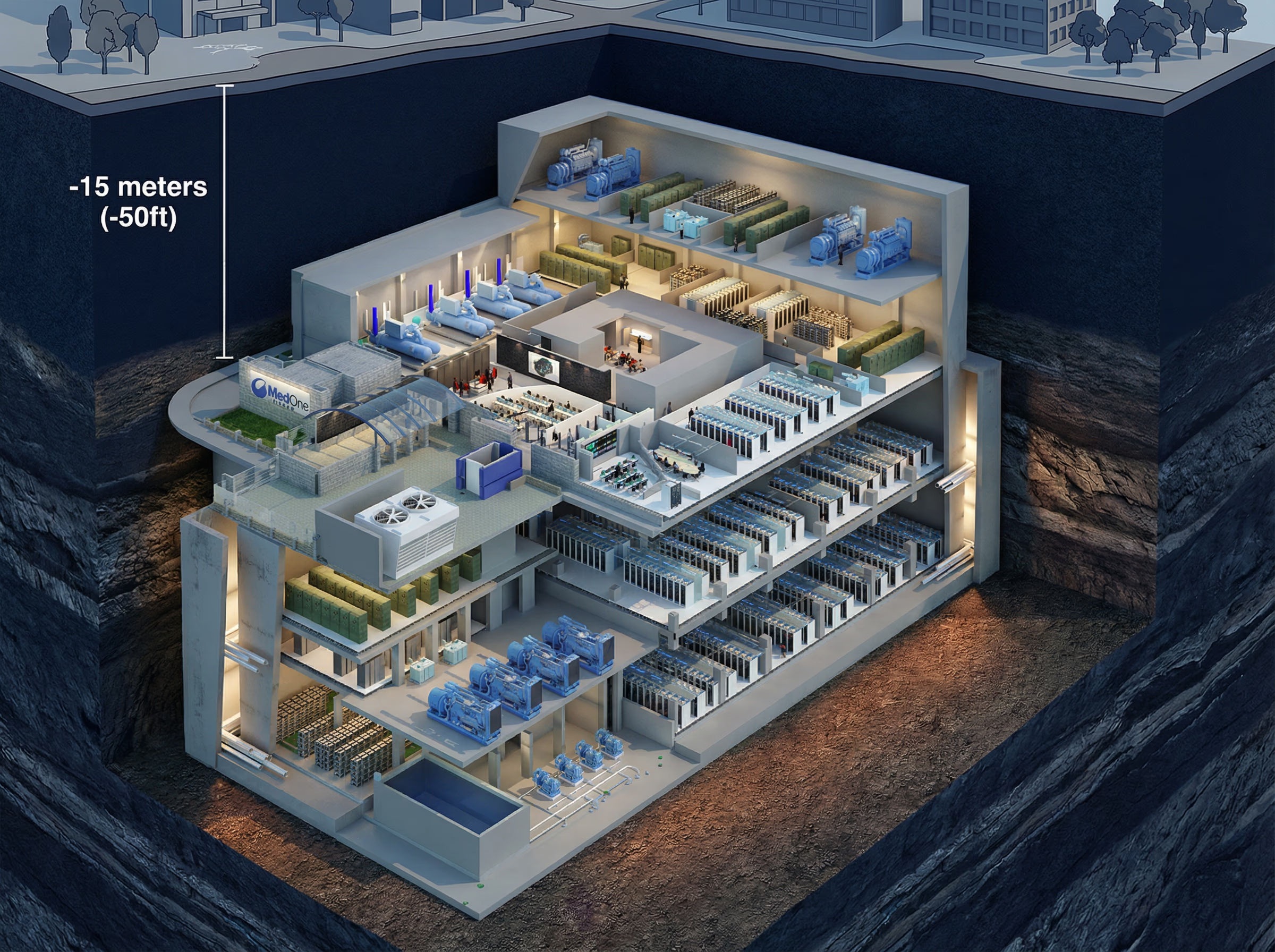
MedOne's flagship facility is constructed 15 meters (50 feet) below ground level. This is not a design choice. It is a deliberate engineering decision that provides physical protection from surface-level threats, improved thermal stability year-round, and structural resilience that no above-ground facility can match.
-15m
Below ground level. Equivalent to a 5-story building depth, providing unmatched physical protection.
4 Levels
Generators, operations, server halls, and infrastructure all housed in separate reinforced underground floors.
Constant Temp
Underground thermal mass reduces cooling load in Israel's hot summers, contributing to a target PUE of 1.3.
Chapter 04
Certifications, Standards and Credibility
The Evidence Behind the Claims
Tier Classification Explained
Tier
Annual Uptime
Max Downtime/Year
Tier I
99.67%
28 hours
Tier II
99.75%
22 hours
Tier III
99.98%
1.6 hours
Tier IV
99.99%
52 minutes
MedOne SLA
99.999%
Less than 5 minutes/year
25+ Years of Operational Excellence
MedOne has operated mission-critical infrastructure in Israel for more than 25 years, serving defense, banking, healthcare, and government. That track record represents infrastructure refined through real-world stress testing, not tabletop exercises.
Full Certification Portfolio
ISO 27001
Information Security Management
ISO 27017
Cloud Security Controls
ISO 27799
Health Informatics
ISO 22301
Business Continuity
ISO 9001
Quality Management
SOC 2
Security and Privacy Audit
SSAE 16
Financial Sector Audit
GDPR
EU Data Privacy Alignment
PPL Amend. 13
Israeli Privacy Law 2024
Chapter 05
Building a Resilient, AI-Ready Foundation
Why Energy Efficiency Is Now a Business Imperative
As AI workloads push rack densities to unprecedented levels, the gap between energy-efficient and wasteful infrastructure translates directly into operating cost and increasingly into regulatory exposure.
PUE 1.3
Target Efficiency (Global avg: 1.56)
Up to 200 kW
Per Rack AI Support
250 MW
New Capacity Underway
What AI-Ready Really Means in 2026
Power density: AI training workloads require 30 to 50 kW per rack. Dense GPU pods demand 60 to 200 kW. A facility that cannot deliver sustained power at these densities is not AI-ready.
Cooling that works in July: Israel's summer temperatures demand cooling systems designed for sustained high-density operation, not just peak-hour management.
Grid independence: AI training runs are continuous and compute-intensive. A power interruption can invalidate days of computation. Multi-path redundancy and generator backup are the baseline.
Low-latency connectivity: AI production workloads need deterministic links to cloud inference endpoints. MedOne's position at Israel's carrier hub eliminates network hops and variability.
MedOne Expansion Locations
MedOne's expansion roadmap adds over 250 MW of IT capacity and 70,000 square meters of new white floor space across four locations, timed to align with Israel's national infrastructure growth trajectory.
Tirat HaCarmelKfar YonaRamleDimona
The Evolution of Data Center Cooling
As AI workloads push rack densities far beyond what traditional air cooling can handle, the choice of cooling architecture has become a strategic business decision. MedOne supports all four generations of cooling technology, allowing clients to match their cooling approach to their actual workload density and budget.
01
Traditional Air-Based Cooling
❄
TechnologyPerimeter CRAC/CRAH units using raised floors with hot/cold aisle containment.
Use Case and DensityStandard workloads below 15 kW per rack.
Key CharacteristicEfficiency drops as density rises. Proven and cost-effective for legacy infrastructure.
02
Close-Coupled Cooling (In-Row and RDHx)
♨
TechnologyCooling brought directly to the row or rack door, shortening air paths significantly.
Use Case and DensityHigh density: 10 kW to 50 kW per rack.
Key CharacteristicHybrid approach requiring coolant piping to the rack level. Widely deployed in modern colocations.
03 AI-Ready
Direct-to-Chip (DTC) / Cold Plate
💻
TechnologyLiquid circulated directly to CPU/GPU processors via cold plates mounted on the chip.
Use Case and DensityAI and HPC workloads. Targets the hottest chips in GPU clusters.
Key CharacteristicHybrid operation: liquid for chips, air still needed for the board. Supported by MedOne for AI deployments.
04 Next Generation
Liquid Immersion Cooling
💧
TechnologyFull hardware submersion in dielectric fluid. No fans required on the server itself.
Use Case and DensityExtreme density: 50 kW to 200 kW+ per rack.
Key CharacteristicLowest PUE possible (below 1.05). Eliminates server fans for lower TCO. MedOne roadmap includes immersion-ready zones.
MedOne Cooling Commitment
MedOne's underground architecture provides a natural thermal advantage: ground-level temperatures in Israel remain stable year-round, reducing the energy required to reject heat. Combined with a target PUE of 1.3 and support for all four cooling generations, MedOne clients can deploy any workload density without infrastructure compromise.